


What is an Interim Manager? Meaning, Benefits and When to Hire One


Short answer: Interim means temporary.
In business, it refers to experienced professionals appointed for a defined period of time, usually during change, transition or uncertainty.
What Does Interim Mean?
The word interim describes the time between two points, typically between now and a future, permanent solution. You’ll see it used in many contexts, for example:
- Interim results
- Interim government
- Interim leadership
In each case, interim means something is temporary, time-bound and intentional, not open-ended.
In a business setting, interim roles are most commonly used when organisations need immediate capability, stability, or leadership during periods of change.
You’ll often see the term used in job titles such as interim CEO, interim managing director or interim manager. In all cases, the principle is the same: someone is brought in for the meantime, with a clear purpose and end point.
Acting vs Interim
The terms interim and acting are often confused, but they are not the same.
An acting role is usually filled by someone internal to the organisation. Their job is to maintain continuity, keep things running, and avoid major disruption.
An interim role, on the other hand, is typically filled by an external professional who is expected to leadchange, make decisions, and improve outcomes.
If stability is the priority, an acting appointment may be appropriate. If transformation or improvement is required, an interim manager is often the better choice.
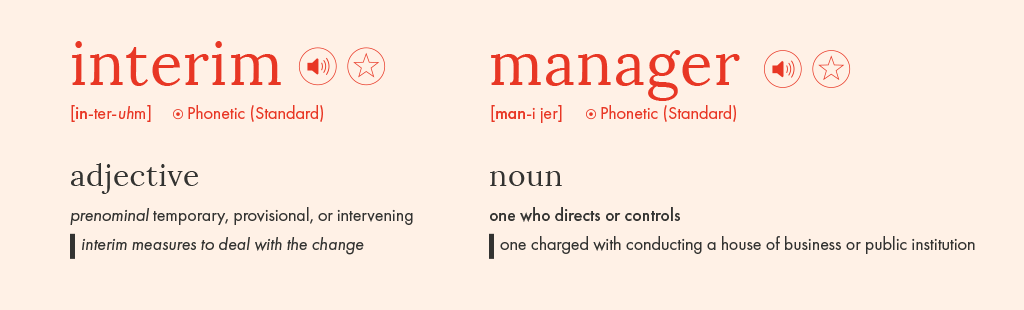
Interim Manager Meaning
An Interim Manager is a senior, external leader appointed to manage an organisation, function, or programme for a fixed period.
Interim managers are typically engaged when:
- A leadership gap appears unexpectedly
- The business is undergoing transformation
- Specialist expertise is required quickly
- Performance needs to improve fast
Unlike permanent hires, interim managers are selected for their ability to deliver impact immediately, rather than for long-term cultural fit.
Interim Leadership Roles Explained
While the underlying meaning of interim stays the same, expectations can vary slightly depending on the role.
Interim CEO
An interim CEO is an external chief executive appointed by the board to lead an organisation during a period of transition, disruption or strategic change.
Unlike an acting CEO, an interim CEO is usually expected to:
- Set direction
- Make strategic decisions
- Lead transformation
- Prepare the organisation for its next permanent leader
Their value lies in confidence, independence, and experience at board level.
Interim Managing Director
An Interim Managing Director is an experienced external MD appointed for a defined period to lead the business through change or uncertainty.
Interim managing directors are commonly used when:
- Performance needs rapid improvement
- A permanent MD has left unexpectedly
- The organisation is repositioning or restructuring
They bring deep operational leadership and are comfortable making decisions from day one.
Interim General Manager
An Interim General Manager is an external individual brought in on a fixed-term contract to manage a business unit or function and achieve specific deliverables. Unlike a permanent general manager, an interim general manager is appointed because:
- The situation requires specialist experience
- The organisation needs immediate capability
- The role is focused on short-term outcomes
Once objectives are met, the interim typically moves on to their next assignment.
Interim Operations Manager
An Interim Operations Manager is similar to a permanent operations manager but is engaged on a temporary basis to address particular operational challenges.They are often used when:
- Processes need rapid improvement
- Efficiency or cost issues must be resolved
- The business is scaling or restructuring
Because of their experience, interim operations managers can identify problems quickly and implement solutions without delay.
Interim Project Manager
An Interim Project Manager is an external professional engaged to lead specific projects or programmes, often during periods of significant change.
Compared to contract project managers, interim project managers are typically:
- More senior
- More experienced
- Trusted with higher levels of complexity and risk
Organisations use interim project managers when they need confidence that critical initiatives will be delivered successfully.
Interim vs Permanent vs Fractional
| Feature | Interim | Permanent | Fractional |
|---|---|---|---|
| Employment Type | Fixed-term contract | Permanent employee | Part-time contract or consultancy |
| Typical Commitment | Full-time | Full-time | 1–3 days per week (or as needed) |
| Duration | 3–12 months | Ongoing | Ongoing or long-term flexible arrangement |
| Purpose | Fill urgent leadership gaps or deliver change | Build long-term capability and stability | Access senior expertise without hiring full-time |
| Start Time | Days to a few weeks | Weeks to months | Usually within days or weeks |
| Primary Focus | Transformation, turnaround, cover, projects | Business growth and continuity | Strategic guidance and specialist expertise |
| Cost | High day rate, no long-term employment costs | Salary, benefits, pension, bonuses | Lower overall cost than full-time executive |
| Flexibility | High – ends when objectives are met | Low – long-term commitment | High – scale time up or down as needed |
| Best For | Change programmes, crisis management, maternity cover | Long-term leadership and organisational growth | SMEs needing executive leadership on a budget |
| Typical Roles | CEO, CFO, COO, HR Director, Programme Director | Any permanent leadership role | CFO, CMO, CTO, HR Director, Operations Director |
| Key Benefit | Immediate impact and rapid delivery | Stability and long-term ownership | Executive expertise with maximum flexibility and value |
Next Steps: Interim Leadership in Practice
Understanding the meaning of interim and what an interim manager does, helps organisations make better leadership decisions during periods of change. Whether the priority is continuity, transformation or rapid improvement, the right interim leadership can make a measurable difference.
If you’d like to learn more about how interim managers are used in practice, explore our interim management services or get in touch for a quick chat!
Need an interim leader? Let’s talk!

Sam Hawkins
CEO
FAQs
What does interim mean in a job title?
It means the role is temporary and time-bound, usually covering a transition, vacancy, or change period.
How long is an interim role?
Most interim roles last between three and twelve months, depending on objectives and complexity.
Is interim the same as temporary?
All interim roles are temporary, but not all temporary roles are interim. Interim roles typically involve seniority, leadership, and accountability for outcomes.
Are interim managers employees?
Interim managers are usually engaged on a contract or consultancy basis rather than as permanent employees.
About Practicus
You can find out more about us on the about us page.
References
- interim (n.), Sep 2022, Online Etymology Dictionary
- manager (n.), Sep 2022, Online Etymology Dictionary