


Why Psychological Safety at Work Is the Foundation of Wellbeing

Charlotte Whitehouse
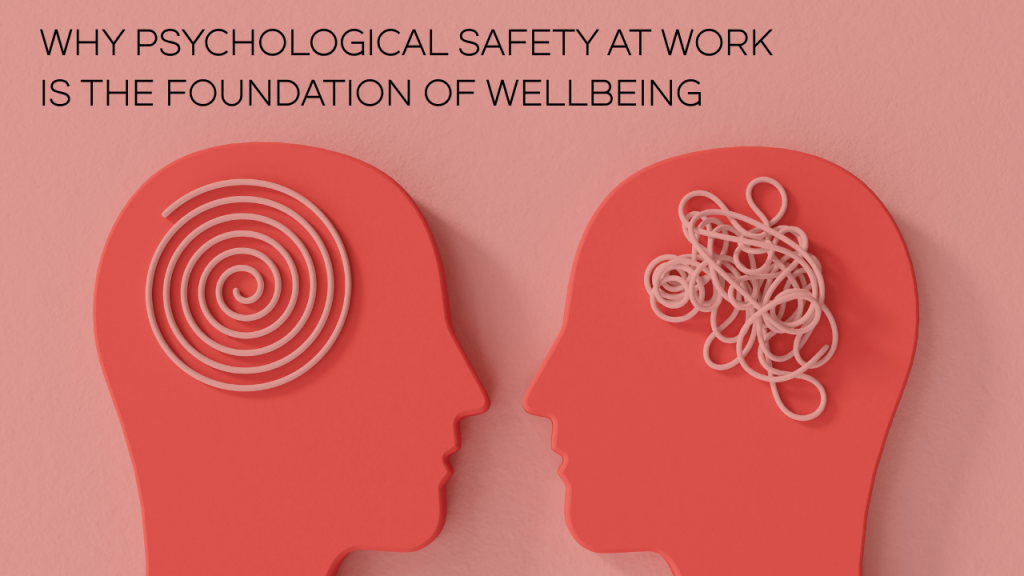
Organisational culture, employee experience, and what actually moves the needle on workplace mental health.
We’ve overcomplicated wellbeing at work. For years, workplace wellbeing strategy has looked like fruit baskets, step challenges, stop-smoking initiatives, discount platforms and the occasional webinar.
All well-intentioned and nice to have, but none of those things fix how work actually feels day to day.
Because wellbeing isn’t a perk. It’s culture, and more specifically, it’s psychological safety at work.
What Is Psychological Safety at Work?
Psychological safety at work is the shared belief that it’s safe to speak up, take risks and be yourself without fear of punishment or humiliation. It’s knowing you can offer feedback and receive it without anxiety, put your hand up when you’re struggling and try something new without worrying you’ll be judged. Show up as your real, authentic self.
Amy Edmondson, the Harvard researcher who popularised the concept, was clear: psychological safety isn’t about making work comfortable. It’s about enabling performance in environments where standards are high. Safety without accountability doesn’t produce great outcomes but pressure without psychological safety erodes everything including trust, confidence, and ultimately, the quality of work itself.
That’s what reduces stress, builds confidence and helps people thrive, not just cope.
Why Wellbeing Initiatives Alone Don’t Work
The reason organisations default to initiatives is straightforward: they’re measurable. You can report on fruit bowl spend and step-challenge participation rates, but you cannot easily report on whether people feel safe enough to say the true thing in a meeting. But measurability isn’t the same as impact.
Our Head of People, Anna Burns, shared an interesting insight on this topic, provoking discussion from HR leaders, organisational leaders, and professionals across industries and the consensus was striking.
As one commenter put it, wellbeing initiatives can only support people when they “sit on top of an environment where people feel safe, heard and respected. That’s where the real impact happens.”
When that foundation is missing, the risk is that every initiative however well designed, starts to feel like a surface fix. You can’t out-perk a culture problem with a fruit bowl!
There’s also a subtler danger, as one respondent noted, when organisations present 15+ types of wellbeing and 30+ daily habits people are supposed to adopt, the end result is that employees feel they’re failing at wellbeing and give up altogether.
What Actually Moves the Needle on Employee Wellbeing
Less is more, and the most important thing is getting the foundations right.
1. Leadership behaviour, not leadership messaging
Empathetic leadership isn’t a soft skill, it’s an operational one. The biggest shifts in employee experience don’t come from adding more services. They come from leaders doing three consistent things:
- Admitting when they don’t have all the answers
- Owning their mistakes publicly
- Responding well the first time someone speaks up
As one commenter shared: “People don’t test safety with big disclosures first. They test it with small ones. A mild disagreement. A tentative idea. A quiet ‘I’m not sure about this.’ How that moment is handled determines everything that follows.”
Teams with fewer perks consistently outperform teams with stacked wellbeing offerings when people feel heard, respected and safe.
2. Work design, not add-ons
Workforce resilience and burnout prevention aren’t built through resilience workshops alone. They’re built through how work is designed.
- Realistic KPIs
- Clear objectives
- Manageable workloads
- Flexible working arrangements
- Clarity of role
These structural conditions matter far more than any individual initiative layered on top.
One reader framed it this way: the gap between what wellness programmes offer and what people actually need is where most wellbeing investment gets lost. The solution isn’t more initiatives, it’s listening harder and designing better.
3. Manager capability as the multiplier
Every wellbeing strategy lives or dies at the line manager level. When managers are skilled at clear communication, tackling difficult conversations head-on, and applying standards consistently, people feel safer speaking up and doing their best work. When they aren’t, no amount of EAP access or mental health first aiders will compensate.
Investing in manager development (not just leadership training, but the daily human skills of trust, fairness, and open conversation) is where the real return on wellbeing investment sits.
4. Individual and organisational work, together
Here’s something the wellbeing conversation often misses: psychological safety creates the conditions, but individuals still need support to operate well within those conditions. Someone who has spent twenty years self-editing before walking through your door won’t suddenly speak up just because the culture has improved.
Cognitive wellbeing, how people think, process, and perform mentally, requires both organisational and individual support. Culture sets the environment. Individual coaching, development, and self-awareness change what happens inside a person when the environment exists.
Most programmes address one, but the most effective organisations address both.
The Business Case for Human Sustainability
Employee trust and engagement are increasingly being recognised as leading indicators of business performance. Organisations that understand wellbeing as an operational, legal, and financial risk (rather than a benefit programme) are the ones making the most meaningful progress.
This shift in framing matters, because when wellbeing is embedded in how work is designed, how leaders behave, and how culture is built rather than bolted on as a series of events, it stops being an initiative and becomes the natural outcome of a well-run organisation.
Some are calling this ‘human sustainability’, the idea that sustainable businesses require sustainable people, and that the duty of care employers owe their workforce needs to operate at a systemic, board-level, long-term horizon, not just through annual mental health awareness campaigns.
What This Means for 2026 and Beyond
The direction of travel is clear.
Organisations making genuine progress on workplace mental health and employee experience aren’t doing so by adding more to the wellbeing calendar, they’re doing it by asking harder questions:
- What in our systems and culture is making people feel unsafe, unsupported or undervalued in the first place?
- Are our managers equipped, not just willing, to lead in a way that builds trust?
- Does our work design allow people to function well and feel good?
- Are our wellbeing efforts shaped by what employees need, or by what’s easy to measure?
Getting the foundations right, culture, leadership, psychological safety, work design is the workplace wellbeing strategy for 2026. Everything else follows from that.
At Practicus, we help organisations build the people capability and leadership foundations that make wellbeing a lived reality, not a policy document. If this resonates, we’d love to talk.
Get in touch!
About Practicus
You can find out more about us on the about us page.
Check out our latest insights here:
- A Cross Functional Guide to AI in Pharma
- PMO Roundtable: How Are People Really Leveraging AI
- Why Employee Onboarding Is Part of the Hiring Process
- The Current Market for Consumer Digital Health Products
- Stop Hiring Reactively and Start Building Intentionally: The Importance of Workforce Planning